
Artist Interview // Art washing in Thamesmead
Art Washing Scandal, Gentrification, and Whose Utopia Gets Built in Thamesmead?

In Thamesmead, artists in need of housing are being accused of gentrification. Dr. Sofia Greaves’ debut exhibition, (Un)Affordable Housing, explores artists’ experiences of affordable housing in Thamesmead and the impact artists have by living and working there. At its center sits a developer’s desk buried under paperwork and riddled with contradictions. Glossy brochures selling Peabody’s vision of a regenerated Thamesmead sit alongside a luxurious crystal decanter. Yet reports of an “art washing” scandal and a photograph of local protesters disrupt the marketing suite fantasy.
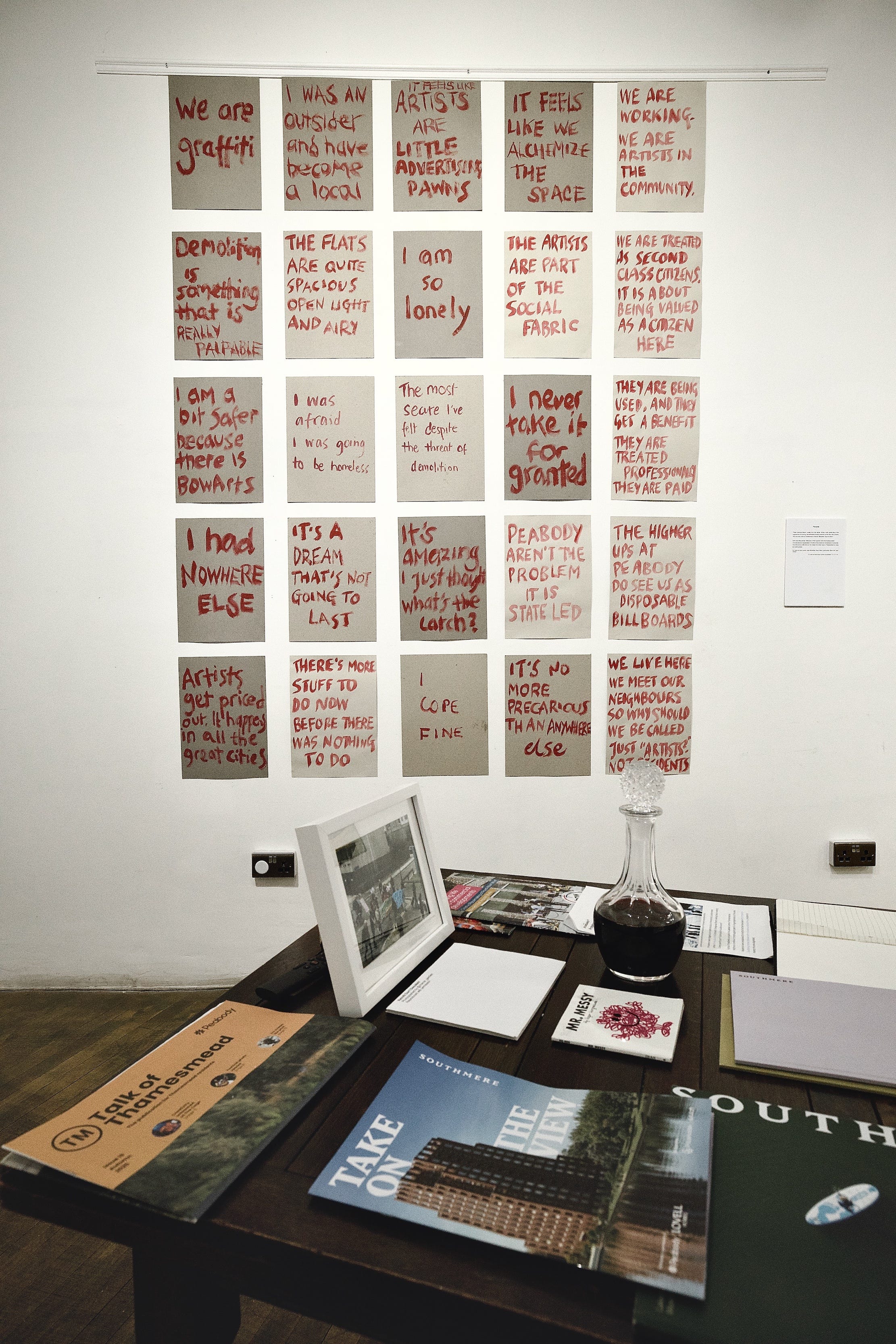
‘The “Affordable” Sitting Room’, 24 placards with anonymised and coded quotes from artists, Marketing suite installation with material from Peabody.
The exhibition examines the Bow Arts guardianship scheme which is delivered through a partnership with Peabody: a housing association and charity. Peabody provides Bow Arts with housing scheduled for demolition, and Bow Arts provides these properties to artists at cheaper rents until demolition occurs. For artists, it’s an affordable space to live and work, despite the precarity. But for some residents, it’s gentrification. The ‘Reclaim Bow Arts’ protest, recently covered by The Guardian, accused Peabody of using artists to rebrand the area for development.
Across the walls, red-inked protest placards by artists read: “Artists are little advertising pawns.” A large crocheted “countermap” holds accounts from residents: “I’m Nigerian and my estate is being gentrified. People like me don’t believe our voices are being heard.”
Greaves, artist and academic researcher, presents Bow Arts as both solution and symptom. She argues that affordable housing for artists shouldn’t primarily be achievable through a symbiotic relationship with regeneration schemes and therefore the displacement of communities.
In this conversation, we discuss her research process, art washing, affordable housing, and the central question: whose utopia is being built?
(Un)Affordable Housing is free at Canvas and Cream until 7th December. View the digital exhibition here
Can you tell me about your background and what led you to create this exhibition?
I am an academic and a researcher working on environmental and social justice issues for the past three years. I have always painted and made art as my way of processing my thinking and research, but I have never presented the research through artistic forms like this before. This is my first ever exhibition and it looks at artists’ experiences of affordable housing in London, specifically through the Bow Arts scheme in Thamesmead.
What do you want visitors to take away from the show?
The big picture here is that the social housing system is broken. While Bow Arts is providing a solution for affordable housing, it is also actually a symptom of the fact that affordability is not possible for artists in other ways. This scheme is reliant on the regeneration scheme, so it’s a “good thing” coming out of the problematic, profit-oriented approach to housing. The takeaway would be that we shouldn’t normalise this kind of solution for social housing needs.
You’ve described yourself as having a creative research philosophy. How do your roles as artist and researcher feed into each other?
This is the question I’ve been asking myself. Whenever I’m doing research, I’m gathering in multimedia ways, taking pictures, writing, or painting to think through ideas. This project was only three to four months, which meant I had to think about the forms the research should take and how they could express the complexity of the issue. A lot of the analysis is embedded in the medium itself. I was lucky enough to be given this newspaper by a resident, which allows me to show multiple perspectives simultaneously. The choice of medium and information in itself is a research decision.
Does visual art allow you to explore ideas that traditional research cannot?
I think we have normative ways of representing knowledge in different disciplines. This shows that using art to research and showcase knowledge can be more effective than written text alone.
Do you think a research-based exhibition requires a fundamentally different approach to accessibility?
I was conscious about how much I should guide people versus allow them to create their own narrative? I’ve tried to create a collage that shows parts of the problem, rather than a linear written argument. It leaves it open because you’re not trying to read my point of view, even though this comes through the work. Here, there’s a lot of info on the walls. It’s about fighting a fixed narrative, allowing you to construct your own opinions based on the information.
“Using art to showcase knowledge can be more effective than written text alone.”
Your PhD focused on utopian city schemes. How does that concept apply to Thamesmead?
I wrote my PhD about utopian city schemes: this notion that a “good” or “ideal” society can be built by shaping the urban environment according to a vision and set of values. The city is seen to be a tool for producing that vision. In planning this notion has been really important because simply having a vision allows you to justify and introduce change. But the crucial questions here concern whose vision it is, how it is implemented, and for whom. Thamesmead was founded in the late 1960 as a utopian settlement for the working class, and then you can see how elements of that vision didn’t come to fruition. On the map I created, you see quotes like “This is the town of tomorrow, a balanced, multi-class community” contrasted with “The inhabitants of Thamesmead come from slum clearance.” This has been typical of ideal city schemes; the ideal and the reality exist in tension with one another, and it is that tension which then justifies the pursuit of a new “vision”, or ideal, as in Thamesmead.
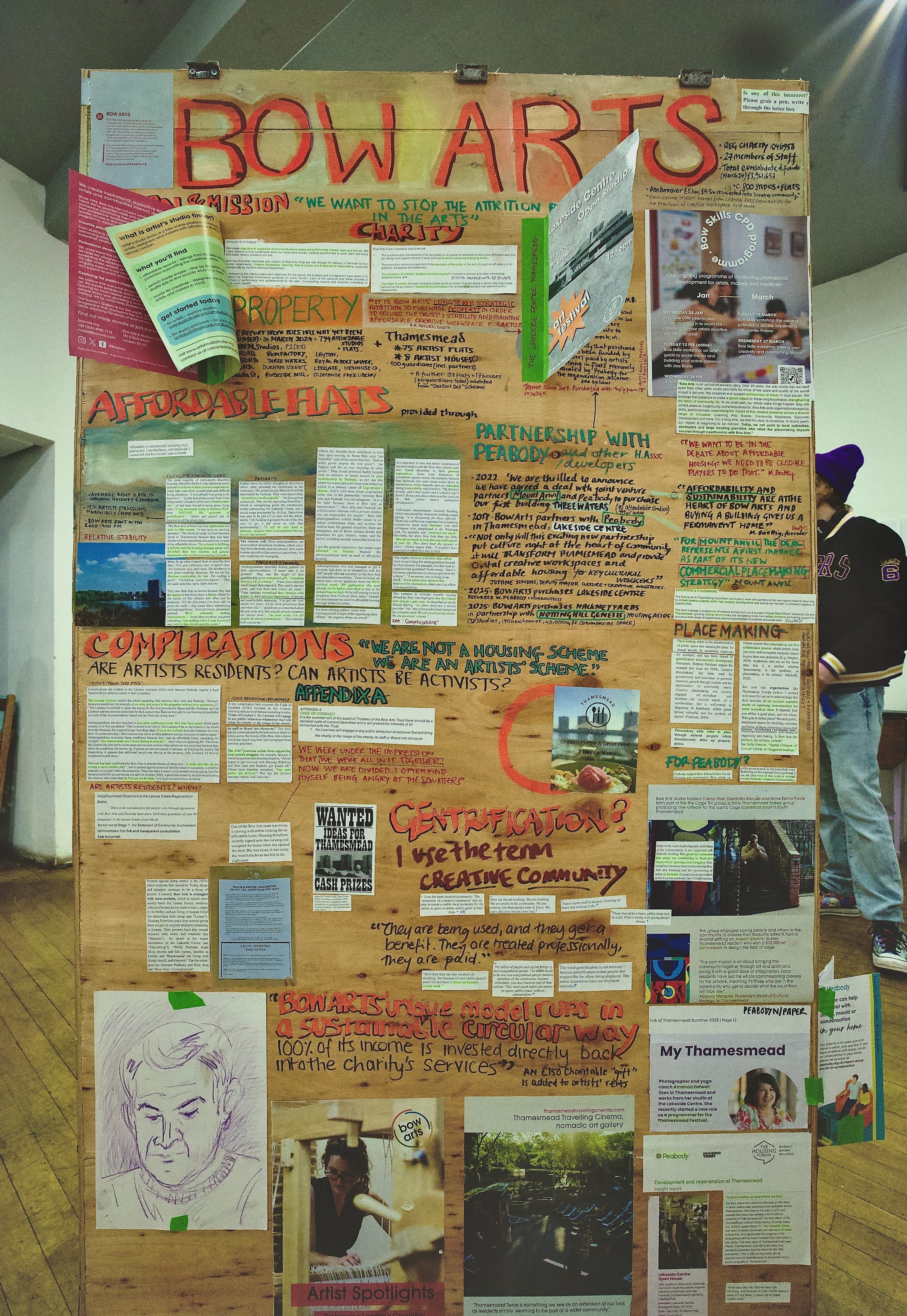
‘The “Affordable” Tower Block’, Archival research, interviews, and gathered material, Wooden packing crate, 165cm x 83cm
Whose utopia is being built in Thamesmead?
The key issue here is that, fundamentally, it is Peabody’s vision of what makes for a good society being built in Thamesmead, because Peabody holds the power to decide what to build, by whom and for whom. Certainly, there has been a long process of consultation, and you will frequently hear the statistic that 70% of residents voted for this regeneration scheme. Equally, this issue is complex. Consider also that the Ballot asked “Do you support the regeneration of the estate, yes or no?” It is a twenty-four page document that did not use the word demolition or demolish, once. It’s also important to consider that Thamesmead had reached the point where the contrast between “the utopia” and the reality had become so great that demolishing and starting again – “regeneration” - seemed to be the obvious option. But was it the only option, and according to whom? And finally, planners claim to have co-created subsequent visions with the community, but we always have to ask how those questions and visions have been framed. Peabody talks, for example, about “inviting local people to shape the future of the town’s trees.” Ok. The question then becomes: what questions am I not being allowed to participate in? What are the power dynamics when thinking about the future of a place?
The map presents an unconventional image of the area. Why did you choose the format of a “countermap” for Thamesmead?
The map is based on images and quotes and ideas that came up in interviews. So it is a “bottom-up” approach to Thamesmead. If you read the quotes you can see the juxtapositions between ideas, so it invites you to think critically because you’re constantly questioning what you just read.
Some quotes stood out to me like “joy of a waterside studio” and “fear of community removal”, they’re so opposing in one piece of work.
Exactly. This sheet is about the protest regarding the Bow Arts building in Thamesmead. You have multiple perspectives: artists celebrating a permanent, affordable space for artists, juxtaposed with a resident who states: “I am Nigerian and my estate is being gentrified. People like me don’t believe our voices are being heard.” An activist critiques Peabody investing in PR instead of real safety. Then there’s a quote from Peabody’s PR. The point is to have all these discordant voices simultaneously, helping you to see from different perspectives.
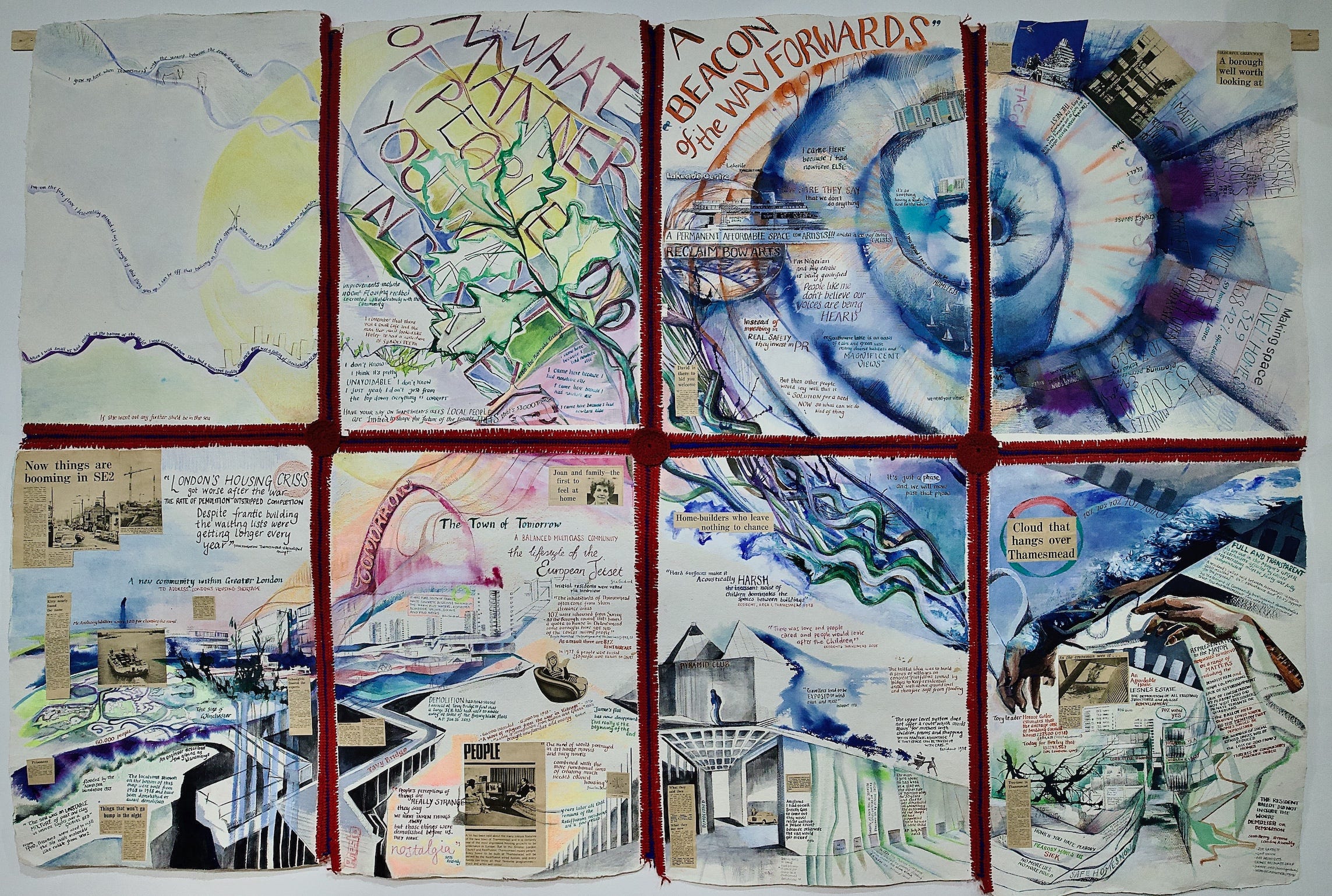
‘Countermap of Thamesmead,’ Sofia Greaves, A Very Strange Tapestry, 2025, mixed media on recycled cotton, joined by wool, 230cm x 150 cm
Can you talk about the crocheted countermap? How did that material choice come about?
I trained in history and worked a lot with maps. I was thinking about how to produce an image of Thamesmead that was about the people and their narratives, particularly the divergent and messy views that get written out from Peabody’s framing of this place. What material can I use for that? The crochet emerged naturally from getting involved in a group run by one of the Bow Arts guardians, Marcus Orlandi. It was really nice, I learned a new skill, and it’s quite a meditative process. I knew I wanted it to be really big, and this is recycled cotton. I did a lot of material tests to figure out how to hold ink best for calligraphy, pencil, thread and paint. The material choice is deliberate: banners have a history in protest, and blankets have a history with people coming together to share stories whilst they crochet.
It’s like a labour of love how much work goes into that, it feels personal.
You can see the making, right? You can actually see the process and the layering. The crochet itself is an indication of the time.
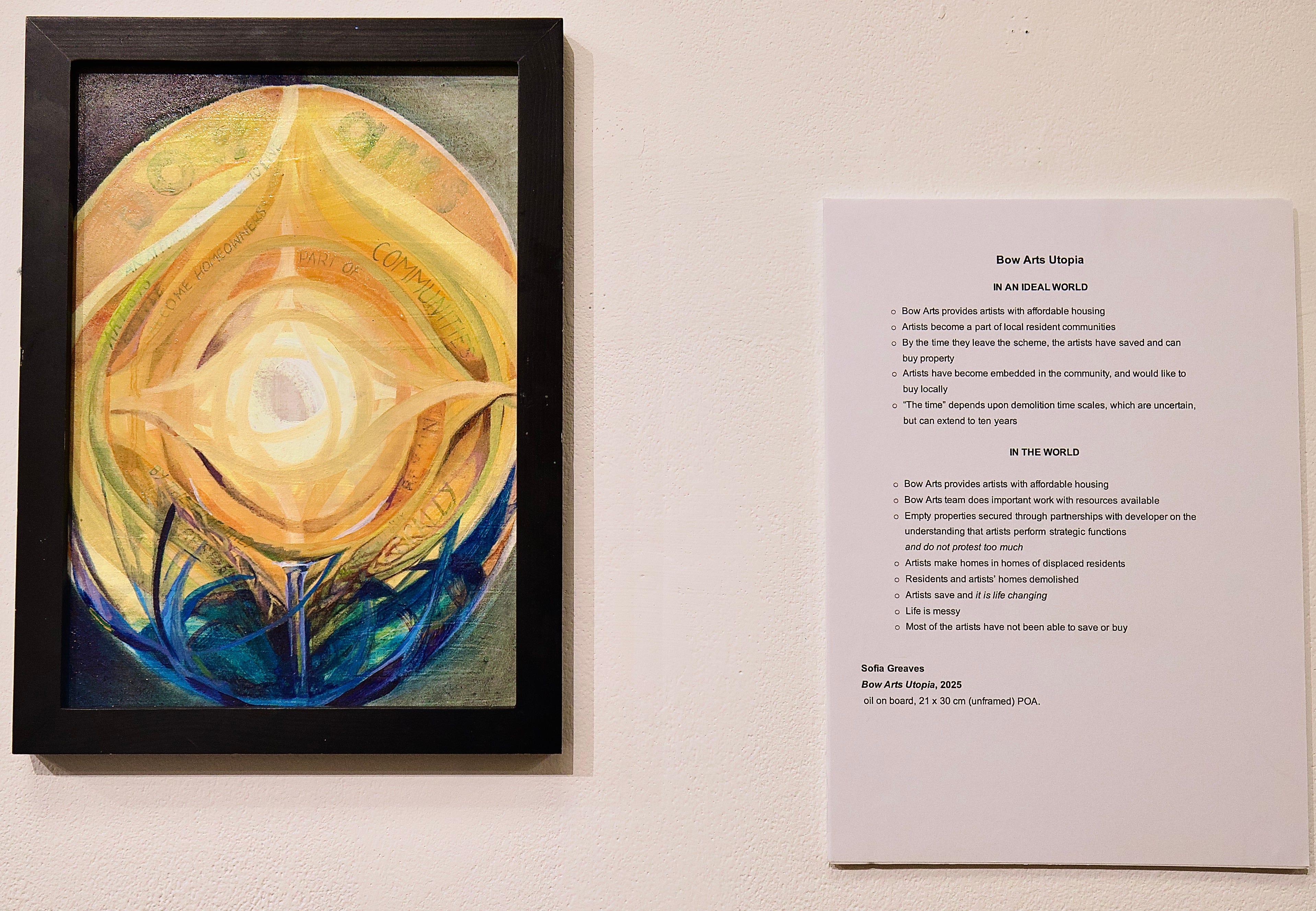
‘The Bow Arts Utopia,’ Sofia Greaves, Oil on board, 22 cm x 30 cm
When I visited the exhibit, your diary entries struck me. It sounded emotionally overwhelming. How did you navigate that?
This is the first time my research has focused on vulnerable people or that I’ve spoken to people in these situations directly. It’s been quite a politically charged period, particularly around housing needs. What I found hard is that when you’re making art, you have to absorb those things to make the work. You can’t end your day and cut off. There was a point where I just felt totally overwhelmed. But at the same time, it’s not my life. I felt this conflict: I am here, but this is their lives, and I am so privileged to be able to go home. It was emotionally difficult as a research process.
“Whose vision is it, how is it implemented, and for whom?”
The research involves sensitive subjects like art washing, regeneration, affordability. What were the barriers you faced during interviews to build trust and have honest accounts?
First of all, I’d say that immediately prior to me doing this research project, Bow Arts did a research project in Thamesmead with 100 artists. Comparatively, I was able to speak to just 15 - I think because there’s research fatigue, and it is exhausting to be studied. Artists don’t have much time, and I can’t pay them. It’s also difficult to talk to me about these issues, because you do put yourself at risk, even if it’s all anonymous. Typically, people aren’t used to being researched. It’s hard to trust people, but I think people heard about the project, and this is often the case, one person really helped me get more people involved. I also live in Forest Hill so travelling three hours a day was tiring, and I had to be careful, it takes a toll emotionally.
There’s something complex about doing research on displacement that itself requires extracting stories from vulnerable people.
I included my diary entries to be transparent about the process and acknowledge my own position. I’m coming in, doing this research, and then I leave. It’s not my life. I had to be really careful with those boundaries.
Can you tell us more about “art washing” and why you included those articles?
The article covers an important debate which happened during my fieldwork. The Guardian Article and the protesters who remain in Thamesmead argue that Bow Arts helps Peabody to rebrand the area. It is clear that the artists’ work is appreciated by Peabody when it contributes to placemaking objectives that by building a different place identity support a rebrand and therefore help Peabody to sell houses. This is important to Peabody, because news coverage always talks about Thamesmead as the “Clockwork Orange estate,” as if that’s the only way people will recognise where it is. One painting references a quote from somebody at Peabody who was frustrated with this association, “only two minutes of the film were shot there.” The great majority of artists will then not be able to afford those houses; they are marketed at young professionals for whom it is important to be “11 minutes from Canary Wharf.” In “Marketing Suite,” you see an ironic juxtaposition: a desk with promotional materials alongside a photo of the protest, and an article about art washing. In the background, the artists’ voices are shown on protest placards, protesting the notion that they are “advertising pawns” or billboards for Peabody’s own artwashing.
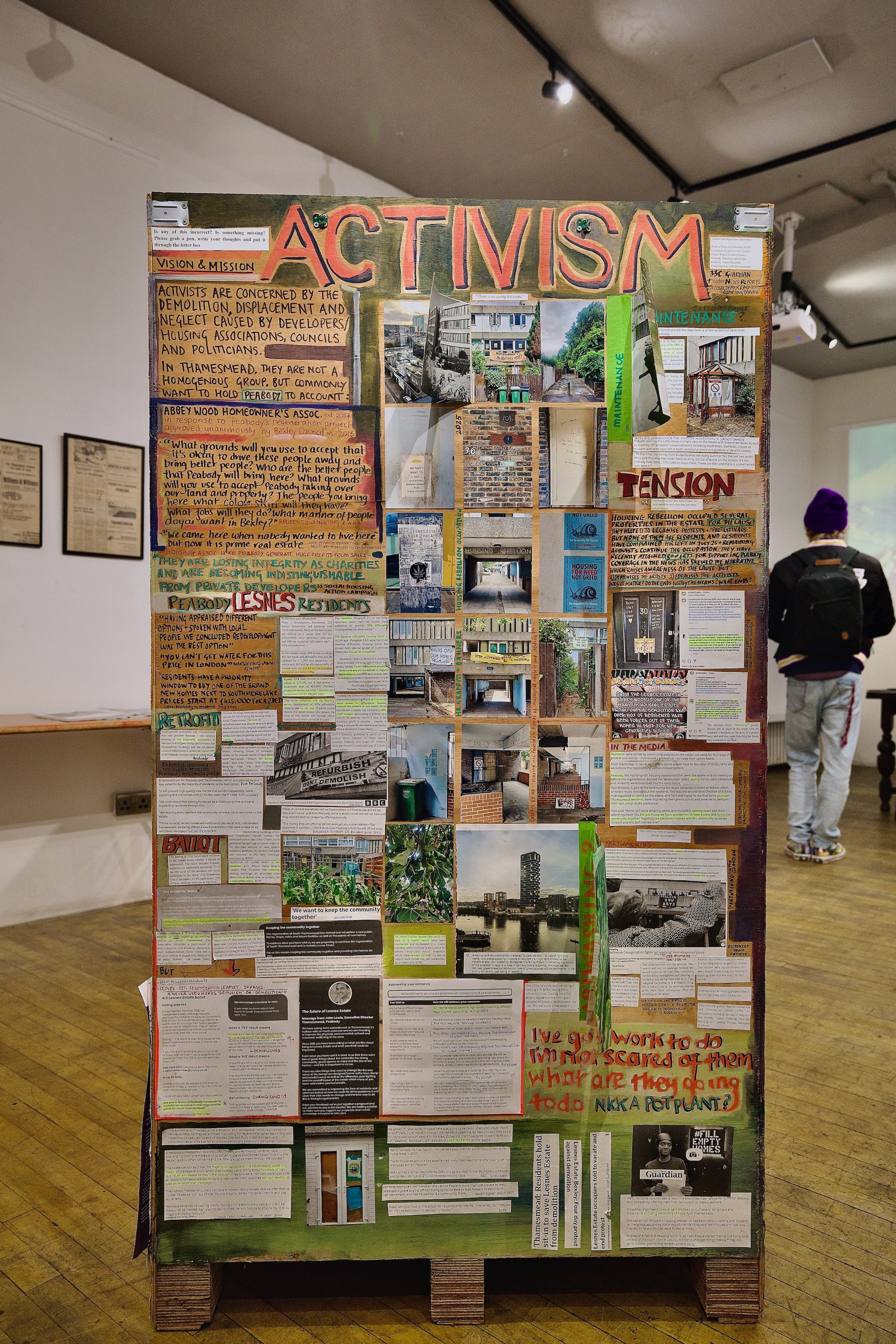
‘The “Affordable” Tower Block’, Archival research, interviews, and gathered material, Wooden packing crate, 165cm x 83cm.
The exhibition has been open for a few weeks now. What’s the response been like, especially from Thamesmead residents?
I’m really pleased that a group of residents from Thamesmead were able to come and visit. I was worried that people wouldn’t be able to afford to travel to see the show. But generally, it’s been received well, and it’s been good being here to talk to people about the work.
What happens next? What do you hope to come from the exhibition?
I’d like the exhibition to be shown at LSE Cities in their foyer, and am going to publish the research in scientific journals. It is also important to recognise that this exhibition shows a snapshot in time, and so I’m interested to see how things develop. It’s just important to keep having these conversations and to make these issues visible. Thank you for including the piece in your research and website.
That's an really informative article on art.
Very well explained
Thanks for sharing and keep writing 💫